

Retrying Failed n8n HTTP Requests Safely
A practical guide to inspecting failed requests, separating recovery logic, bounding retries, pacing rate-limited traffic, and filtering duplicate inputs before an API call can create side effects.

Checked against the n8n documentation on .
Begin with evidence from the failed execution
A safe retry starts with inspection, not an immediate rerun. Open the failed execution, locate the HTTP Request node, and preserve the input that produced the failure. n8n lets you review executions by status and manually retry a failed execution using either the currently saved workflow or the original workflow. That choice matters when you have edited the workflow since the failure: decide whether you are reproducing the earlier behavior or testing a correction.
Configure the request step to return the full response when that information is available. The response status code and headers, alongside the body and any service message, give you evidence for deciding what happened. Record the request context as well: the operation being attempted, the destination, and a safe identifier for the affected item. Avoid placing secrets or sensitive payloads in diagnostic fields.
Manual retry is useful for investigation, but it is not a complete recovery policy. As cautious editorial advice, consult the target API’s documentation and verify the external state before repeating an operation that creates, updates, sends, or charges something.
Classify failures before deciding to retry
Treat retry eligibility as a decision based on the target API’s documentation and the evidence returned by the request. A rate-limit response may be temporary, while an authentication or validation problem may require a corrected credential or payload. These are illustrative categories, not universal rules: each service defines its own status codes, error bodies, request semantics, and limits.
A useful suggested classification is temporary, permanent, and uncertain. Temporary failures can enter a bounded retry path when the service permits it. Permanent failures should leave the retry path and produce a clear record for correction. Uncertain failures deserve special care when the request can create an external side effect, because repeating them may repeat the action.
Do not build a rule that retries every non-successful response. Instead, make the allowed conditions explicit and keep an intentional fallback for everything else. Full response data can support this classification, but the available documentation does not establish a universal set of safe HTTP errors or methods to retry.
Separate recovery from the success path
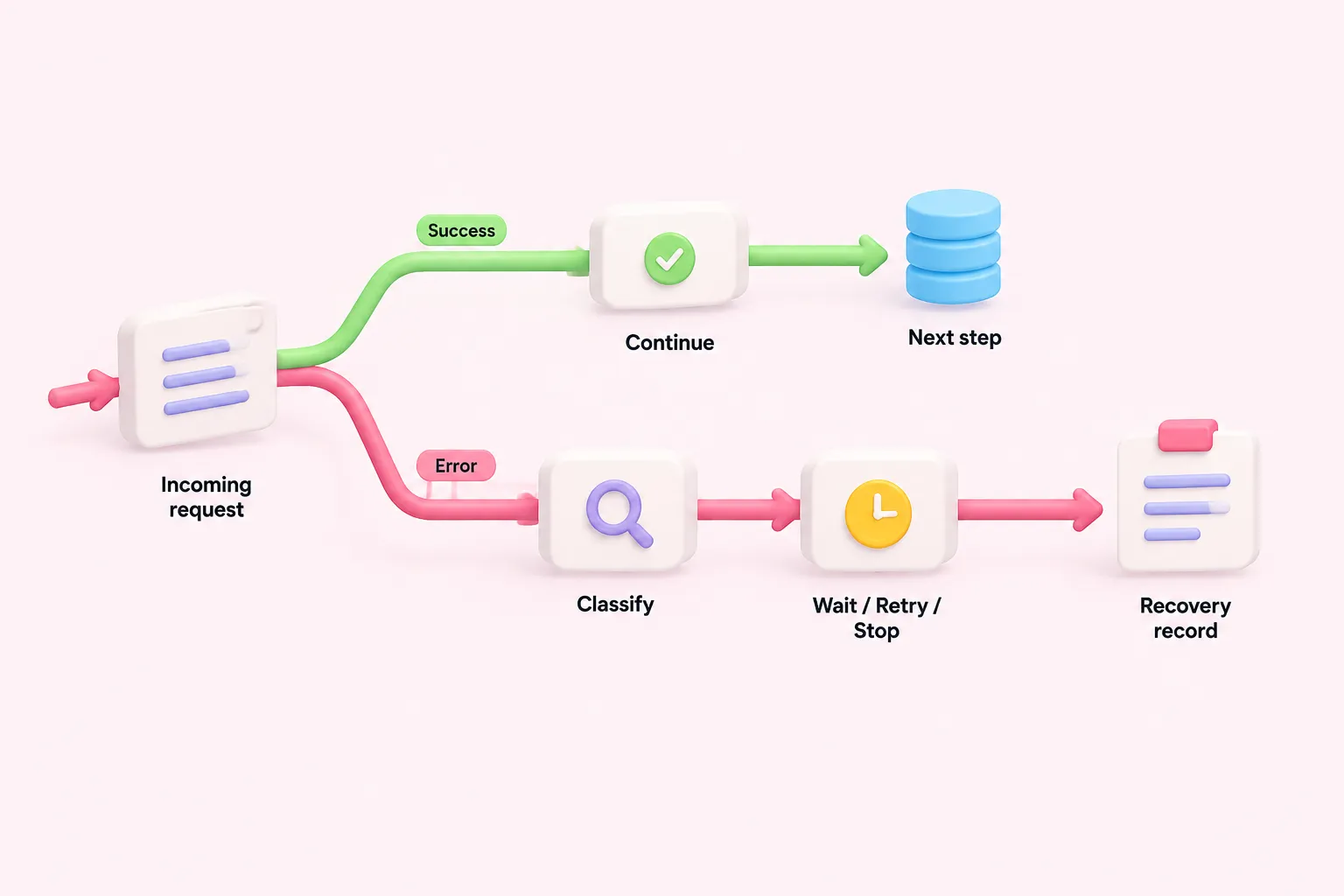
Keep normal processing easy to follow by routing failures into isolated recovery logic. A node can continue through a dedicated error output and pass error information to downstream steps. That branch can normalize the error, classify it, record useful context, and decide whether the item should wait, retry, or stop.
Use this local branch when the decision belongs to a particular request or item. For broader workflow-level failure handling, n8n also supports reusable error workflows that begin with an Error Trigger and can serve multiple workflows. Such a workflow can centralize failure handling, but the supplied documentation does not establish it as the right mechanism for every item-level HTTP recovery case.
A suggested recovery record could contain a safe item identifier, an error category, the attempt number, and the next action. This is an editorial framework rather than a validated schema. Its purpose is to make decisions visible without mixing failure-handling nodes into the main success route.
Bound and pace retries for rate limits
n8n documents two relevant approaches to rate limits: enabling Retry On Fail, or pacing work with Loop Over Items and Wait. Choose the delay according to the target service’s published limit. For a larger collection, deliberate pacing can be clearer than repeatedly hitting the limit and treating failures as the traffic-control mechanism.
Set a maximum number of attempts as an explicit design choice. The supplied documentation does not provide a universal maximum, exponential-backoff formula, jitter rule, or policy for Retry-After headers, so values must come from the target API’s guidance and your workflow’s risk tolerance. When the limit is reached, route the item to a visible exhausted-retry outcome rather than allowing an indefinite loop.
Keep the original business identifier and increment an attempt counter through the recovery branch. Before every new attempt, confirm that the error still qualifies and that repeating the operation remains acceptable. Retry controls reduce uncontrolled repetition, but they cannot establish that a side-effecting call is safe on their own.
Sources: S6
Deduplicate before side-effecting requests
Place duplicate filtering before an HTTP request that might create or change an external record. The Remove Duplicates node can compare a unique input field, or a combination of fields, and filter values already seen in previous executions. Prefer a stable business identifier over a value that changes on every run.
Choose the comparison scope with care because deduplication history is bounded and configurable. A suggested key might combine a source record identifier with the intended operation, provided that combination represents one logical action in your own process. This is a design suggestion, not a universally validated key.
Input deduplication is a safeguard against repeated processing, not a guarantee of exactly-once delivery. It does not prove that an external service avoided a repeated side effect. Where an API provides its own idempotency mechanism, evaluate it using that API’s documentation rather than assuming n8n-side filtering replaces it.
Sources: S8
Test success, exhaustion, and duplicates
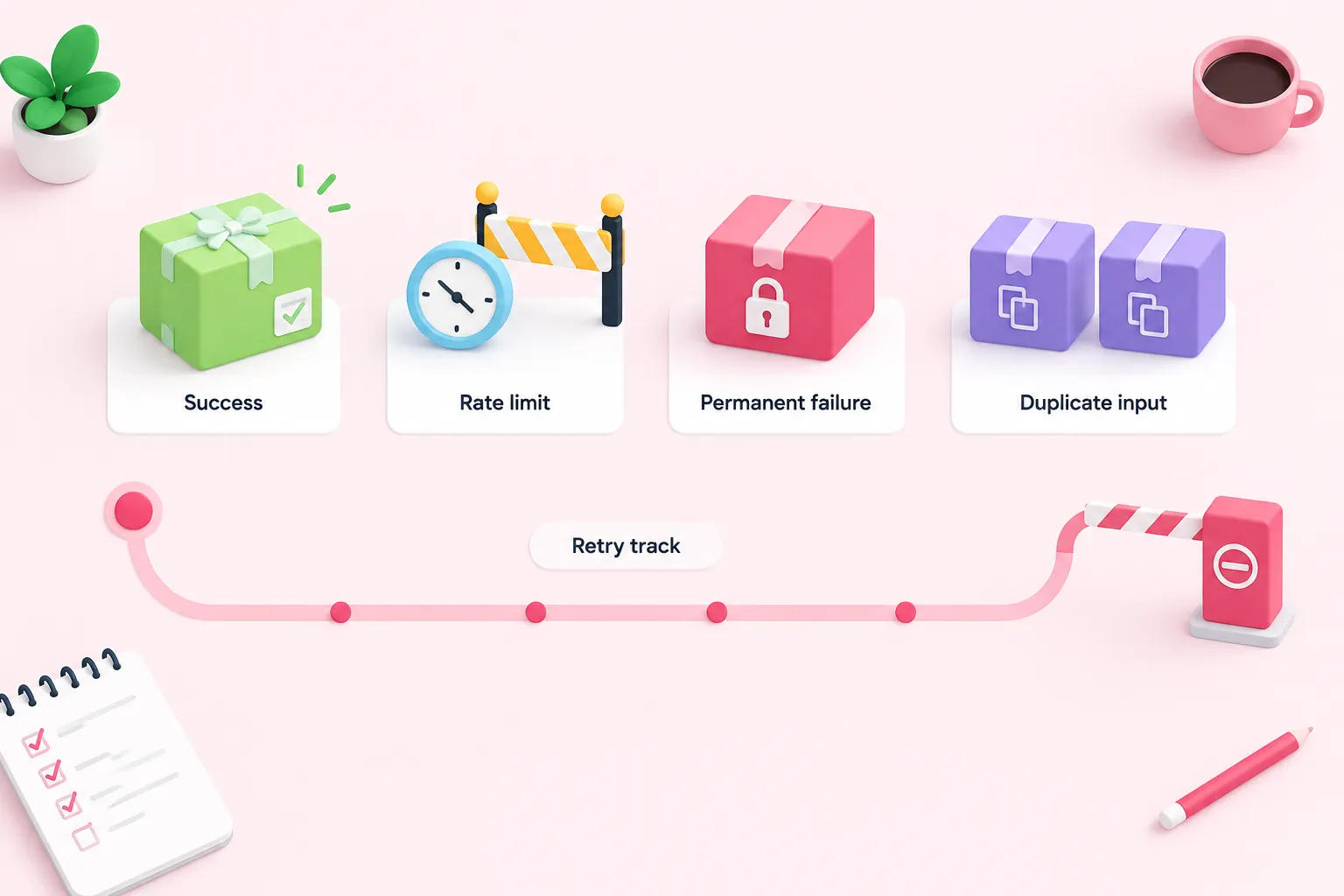
Test the recovery design before relying on it. A suggested test set includes a successful response, a simulated rate-limit response, a permanent failure, and the same logical input submitted twice. These scenarios are practical editorial suggestions, not a validated testing instrument.
For each scenario, inspect both the execution route and the final external effect. Confirm that success avoids the error branch, an eligible temporary failure follows only the permitted number of attempts, a permanent failure does not enter an automatic retry loop, and retry exhaustion reaches a visible stopping point. For duplicate input, verify what the filtering node does within the scope you configured.
Manual retry deserves its own test. Compare retrying with the saved workflow against retrying with the original workflow so you understand which version is being exercised. Finish by reviewing logs and stored error context for sensitive information. The goal is a workflow whose decisions can be inspected, reproduced, and corrected without implying that retries or deduplication guarantee delivery.
Practice the complete recovery pattern
Build a small practice workflow that receives sample items, filters repeated identifiers, calls an HTTP endpoint, and routes request errors into a separate recovery branch. Add an explicit stopping condition and a visible exhausted-retry outcome. Then run the suggested scenarios one at a time and inspect how data changes at every node.
Keep the exercise focused on the pattern rather than a particular retry number. The appropriate errors, delays, request methods, and external idempotency protections depend on the API being used. Treat each service’s documentation as the authority for those choices.