

Production approval checklist for imported n8n workflow templates
A practical checklist for reviewing ownership, security, credentials, data behavior, access, execution evidence, and rollback readiness in n8n.

Checked against the cited sources on .
1. Establish the workflow’s purpose and boundaries
Check: As an editorial production-readiness criterion rather than an n8n-mandated standard, name a business owner and a technical owner. Document the workflow’s intended outcome, trigger, connected systems, expected inputs and outputs, and the people affected by its actions. Completion means a reviewer can explain what the workflow should do—and what it must not do—without relying on the template’s title or notes.
Check: Inventory every node, integration, webhook, database operation, filesystem interaction, and external destination. Mark any community or unfamiliar node for further investigation. This inventory is an editorial approval suggestion, not an n8n-mandated standard, but it gives later security and access decisions a defined scope.
Check: Define the production boundary. Record which environment will run the workflow, the expected invocation pattern, whether overlapping executions are acceptable, and which external actions could be difficult to reverse. As an editorial production-readiness criterion rather than an n8n-mandated standard, document rollback evidence and an agreed action before approval: disable the workflow, restore a reviewed version, revoke credentials, or use another procedure appropriate to the company. Completion means the owners have agreed on a specific response if deployment causes an unexpected result.
Sources: S1
2. Review security-sensitive behavior and instance findings
Check: Run the n8n instance security audit and preserve its results with the review record. Investigate findings related to the imported workflow and its operating environment. A clean or improved report is evidence for review; it is not proof that the workflow is secure.
Check: Examine every built-in node that n8n classifies as risky. For each one used by the template, document why it is necessary, what data and resources it can reach, and whether a less privileged design would satisfy the same purpose. Do not approve a node merely because it was included by the template author.
Check: Trace possible data paths beyond the visible node canvas. Consider webhook responses, outbound requests, logs, downstream nodes, database access, and filesystem interactions. If execution-data redaction is available in the company’s supported Enterprise version, it can hide node input and output payloads from workflow viewers while retaining metadata. It must not be treated as backend access control or as protection for every other data path.
Completion means the audit results, risky-node decisions, exposed data paths, and applicable instance settings have named reviewers and recorded outcomes. Any unavailable edition- or version-dependent control should be marked as not applicable rather than silently counted as passed.
3. Replace and restrict credentials
Check: As editorial production-readiness checks rather than n8n-mandated standards, review every imported credential reference, replace it or deliberately bind it to a company-managed credential, and record its owner, target service, permitted resources, storage location, and revocation procedure. Do not assume that a reference carried over with the intended ownership or scope.
Check: Prefer OAuth for supported third-party applications. Verify the scopes that the service actually grants, because OAuth capabilities and revocation behavior vary by provider. Where an API key is required, restrict it to the smallest practical set of resources and operations, then document that scope.
Check: Test credential failure without exposing secrets. Suggested cases include an expired authorization, a revoked test key, or a denied operation outside the permitted scope. These are editorial test suggestions, not validated security tests. Completion means the workflow succeeds with the intended authorization, fails visibly when access is unavailable, and has no unexplained credential dependency.
Sources: S5
4. Verify mappings, transformations, branches, and item linkage
Check: Separate mapping from transformation during review. In n8n, mapping references data produced by earlier nodes; it does not itself change that data. List each important mapped field, its source node, its expected type, and its behavior when the value is missing. Identify transformation rules separately so reviewers can see where values are modified.
Check: Use representative non-production inputs for the expected case and suggested edge cases such as empty values, malformed fields, multiple items, unexpected types, and alternate branches. These cases are editorial suggestions rather than a validated test suite. Compare observed outputs with documented expectations and check that sensitive fields do not travel to unnecessary destinations.
Check: Where programmatic nodes produce multiple items or feed branches, inspect input-output item linkage. Missing linkage can cause downstream expressions to break, while declarative-style nodes may handle linkage automatically. Completion means multi-item and branching runs produce the intended downstream references without unexplained mismatches.
5. Promote a reviewed version through a controlled process
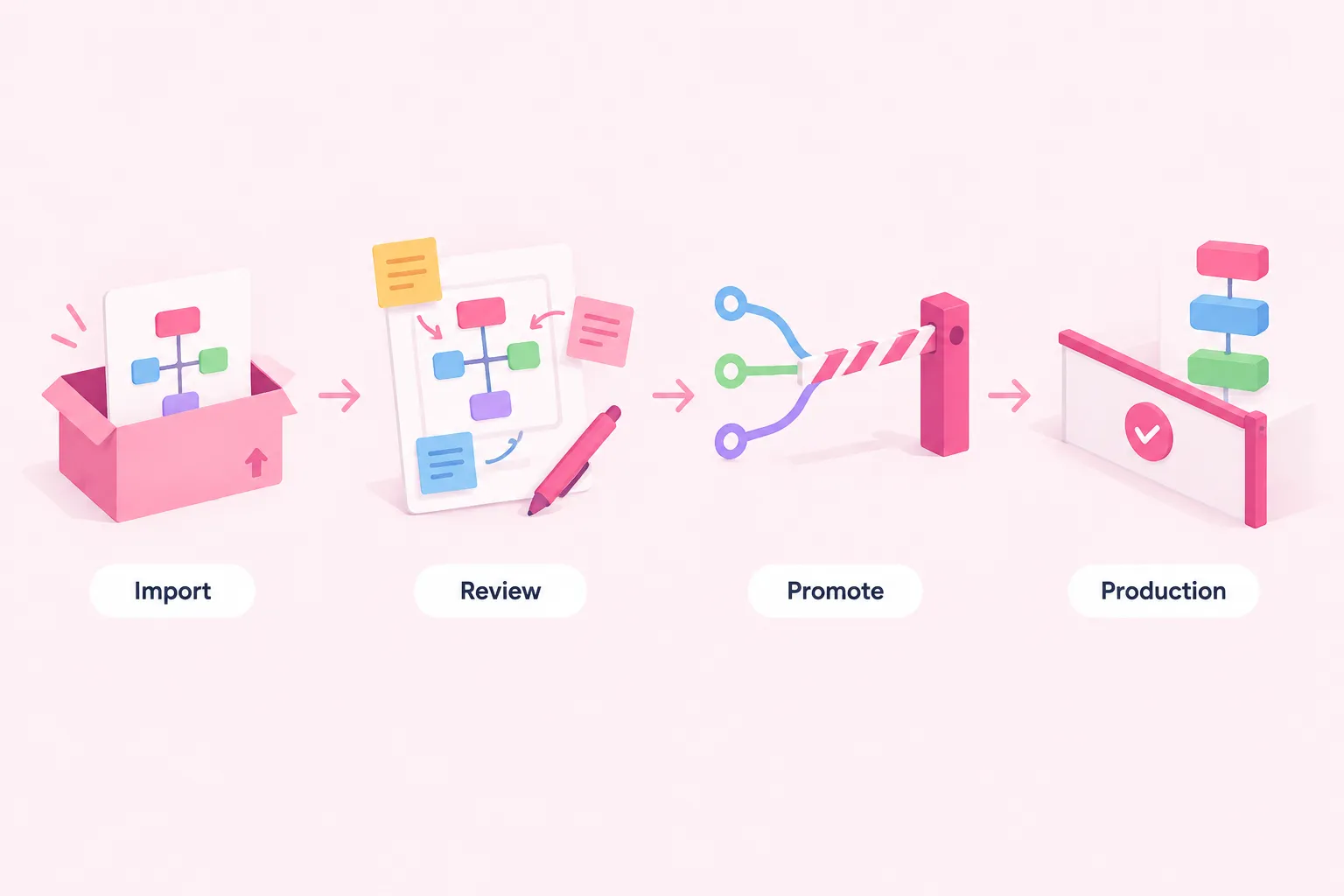
Check: As editorial production controls rather than n8n-mandated rules, identify the exact saved workflow version being approved, record who reviewed it, document what changed from the imported template and which environment supplied the test evidence, and prohibit unreviewed edits from being treated as part of the approved artifact.
Check: Where the applicable n8n plan and administrative setup support source-control environments, link environments to Git branches and use the documented push-and-pull model as a promotion boundary. Requiring review of the version moving toward production is an editorial control. Because this capability is limited to relevant Business and Enterprise configurations, teams without it could consider editorial alternatives such as preserving an exported artifact, performing a peer comparison, and naming a deployment approver.
Completion means production receives the same reviewed logic and configuration intended by the approval record. This completion gate is an editorial production control. Secrets and environment-specific credential bindings should be checked separately rather than inferred from source control.
Sources: S2
6. Test success, failure, retry, and troubleshooting paths
Check: Run the normal case and inspect the execution available to the authorized reviewer. Record the input category, execution status, important outputs, and any external side effects. Execution visibility depends on workflow or project access, and deleting a workflow also removes its execution history, so preserve the approval evidence according to company policy.
Check: Deliberately exercise meaningful failure paths in a non-production context. Suggested cases include invalid input, unavailable test services, denied authorization, and a controlled downstream error. Confirm that the failure can be found and understood without revealing unnecessary sensitive data.
Check: Assess replay risk before retrying a failed execution. n8n supports retrying failed executions, but that does not establish automatic node retries, idempotency, or safe replay when external side effects are involved. Determine whether another attempt could duplicate a message, record, payment-like action, or other external change. Completion means both successful and failing behavior have been observed, and any retry decision is tied to a workflow-specific side-effect assessment.
Sources: S3
7. Confirm workflow, credential, and execution access

Check: List the people or groups who can view, edit, run, or share the workflow and inspect its executions. Review workflow and project membership together, because execution visibility depends on access to the relevant workflows.
Check: Include credential effects in the access decision. Workflow sharing may allow editors to use every credential referenced by that workflow, so access cannot be approved by looking only at canvas visibility. For each intended editor, confirm that using the connected credentials is necessary for the person’s role.
Check: Apply least privilege as the completion test: each named user should receive only the workflow and credential access needed for assigned responsibilities. This reflects n8n’s described sharing principle, but it does not prove that a particular company configuration satisfies its internal access policy. Hosting model, plan, project setup, and custom roles may affect the available controls.
Check: Decide whether execution payloads contain sensitive information and who may inspect them. If redaction is available and appropriate, use it as a viewer-level visibility control while continuing to assess backend storage and other data paths separately.
8. Create the approval and rollback record
Check: As editorial governance suggestions rather than mandatory n8n standards, give every checklist section a status such as pass, fail, not applicable, or remediation required, and record the reviewer, evidence location, decision date, remediation owner, and residual risk.
Check: The following are also editorial controls rather than n8n requirements: make approval conditional on unresolved issues being explicit; require each compensating control to identify the risk it addresses, its owner, and the condition for disabling or reviewing the workflow again; and require later template changes to undergo a fresh review instead of inheriting an earlier risk acceptance.
Check: As an editorial pre-activation control, reconfirm the rollback action, credential revocation path, and responsible owner immediately before production activation. The final completion gate is also an editorial governance suggestion: the organization should be able to identify the approved version, understand remaining risks, restrict access, inspect relevant execution evidence, and respond to an adverse deployment without inventing the procedure during an incident.