
n8n Code Review Exercise: A Peer Review Drill Before Merge
An editorial n8n code review exercise: a checklist for error handling, credential scope, commit messages and idempotency, using n8n version control for git before merge.

Checked against the cited sources on .
Editorial exercise: pair review of a workflow change before it reaches a shared n8n instance
This n8n code review exercise is an editorial drill, not a certified curriculum: it asks a reviewer to sit down with a teammate's workflow change and decide, on paper, whether it's ready to merge into a shared n8n instance. The task: pick a recent or hypothetical change — a new node added to an existing workflow, an edited Code node's JavaScript, or a widened credential scope — and run it through the checklist in this exercise exactly as if it were a pull request waiting for your sign-off.
n8n's own blog frames this kind of gate directly: a 2026 post describes a pull request as the checkpoint between a development change and whatever runs in production. That's the spirit of this exercise — borrow the discipline of a software pull request and make it one of your team's n8n good practices, even though a workflow isn't quite code.
Sources: Workflow Versioning for Reliable Automation and Maintenance – n8n Blog
Prerequisites: n8n version control for git access and the inputs you'll review
Before you can run this exercise, your team needs its workflows connected through n8n version control for Git, so a change actually exists somewhere a reviewer can open it. n8n's documentation lists the prerequisite plainly: a Git repository reachable either by SSH deploy keys or by HTTPS access with a personal access token. Without that connection, there's no diff to review in the first place.
The reviewer also needs a seat with access in the Git provider and, ideally, enough workflow-sharing visibility inside n8n to open the change in the live editor. n8n's documentation states that workflow sharing is available on every n8n Cloud plan but only on the self-hosted Business and Enterprise plans, which means a reviewer on self-hosted Community Edition can read the Git diff but can't open the other person's workflow in-instance to click through it. Agree on a branch pattern before you start — one branch per change, reviewed before it's pulled into the shared production branch.
The input for this drill is the change itself, pushed to that repository: pick one of a new node, an edited Code node's JavaScript, or an altered credential scope, so the review has something concrete to examine rather than a whole workflow at once.
Sources: Set up source control | Administer | n8n Docs, Share with others | Build | n8n Docs
Constraint: why n8n's source control doesn't include a review screen
Here's the constraint that shapes the whole exercise: n8n's documentation is explicit that its source-control feature doesn't include a pull-request-style review-and-merge screen inside n8n itself. If you want that checkpoint, it has to happen outside n8n, in whichever Git provider you've connected. We think that's the right trade-off rather than a gap to work around: a Git provider's review tooling is more mature than anything a workflow tool would build from scratch, so routing review there plays to each tool's strength.
In practice, that means your actual review happens as comments on a pull or merge request in GitHub, GitLab or whichever provider you use, before anyone pulls the branch into the shared n8n instance. Treat that PR thread, not any screen inside n8n, as where this n8n code review actually happens and gets recorded.
Sources: Use Git in n8n | Administer | n8n Docs
Review checklist: error handling, credential scope, commit messages and idempotency
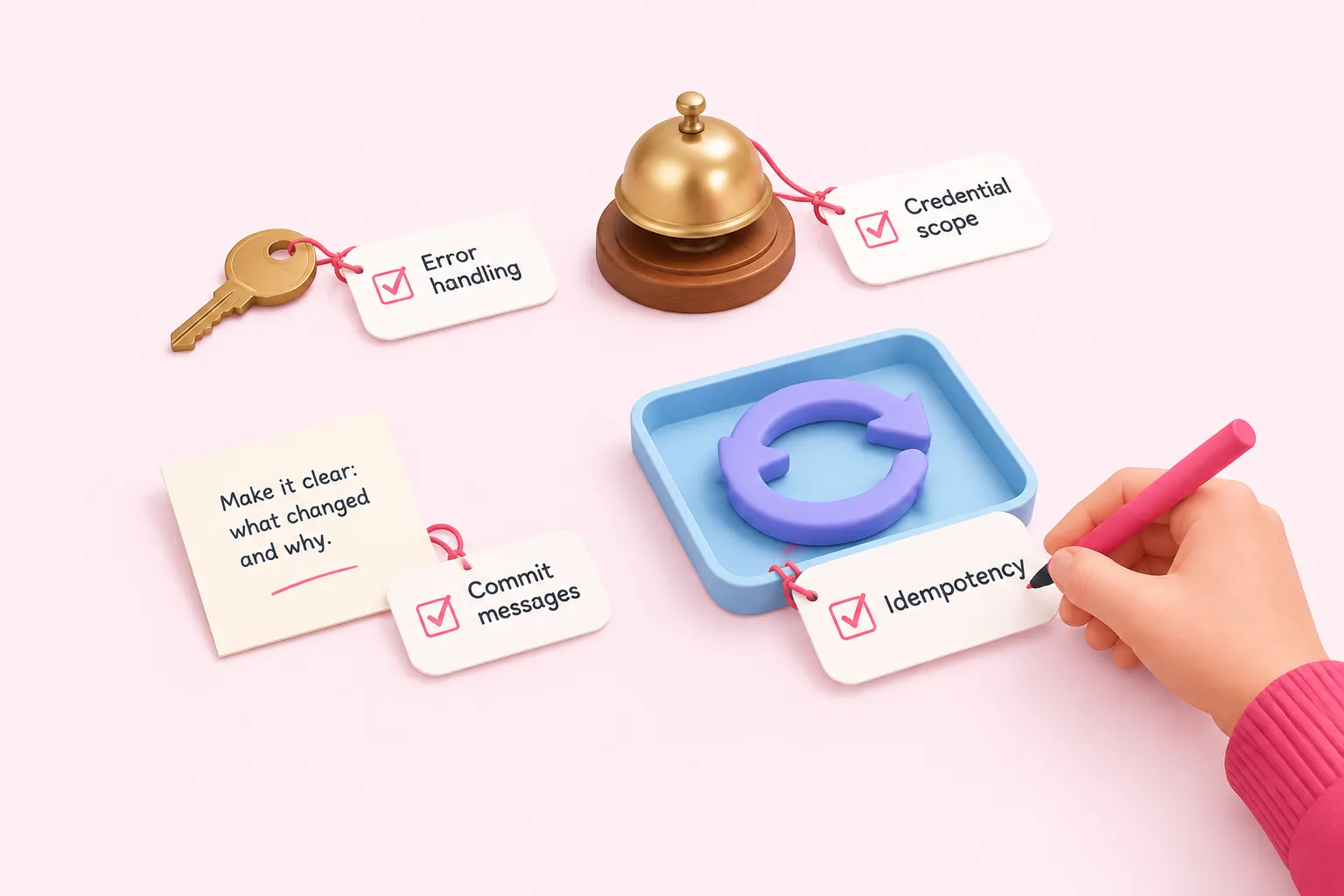
With the change open in your Git provider's diff view, four checks make up the core of this n8n code review.
n8n's documentation ties the first check to a specific node: the Error Trigger is what creates a dedicated error workflow, but it only fires when an automatic, non-manual run errors. So a change tested only by hand won't exercise it, and a reviewer who only sees a passing manual test hasn't actually confirmed the error path works.
The second check follows directly from how n8n handles shared credentials. n8n's documentation states that a teammate given access to use a shared credential still can't view or edit the credential's own details, and separately that someone without that share can't edit nodes using it at all. A reviewer can use that boundary to ask a simple question: does this change widen who can use a credential, and if so, is that widening actually necessary?
| Check | Basis |
|---|---|
| Error handling | Based on n8n's documentation for the Error Trigger node |
| Credential scope | Based on n8n's documentation on credential sharing permissions |
| Commit messages | Based on n8n's 2026 blog recommendation |
| Idempotency | Editorial addition; not documented in n8n's own materials |
For the third check, n8n's 2026 blog post puts it simply: a commit message should tell the next person what changed and why, not just relabel the file. Reject a message that only says something like 'update workflow.'
The fourth check isn't in n8n's documentation at all — it's editorial judgment worth adding anyway. Ask whether re-running the changed workflow with the same input would create duplicate records, duplicate emails or duplicate charges. We'd flag idempotency as worth checking every single time, even though it's our own editorial addition rather than a documented n8n practice, because duplicate side effects are an easy thing for a code diff to hide.
Sources: Error Trigger | Nodes | n8n Docs, Share with others | Build | n8n Docs, Share credentials securely | Administer | n8n Docs, Workflow Versioning for Reliable Automation and Maintenance – n8n Blog
Completion criteria and reflection
This exercise is done when four things are true, in order: the reviewer has left comments on the pull or merge request addressing all four checks above; the author has responded to or amended the change; the reviewer has approved the merge in the Git provider; and only then is the branch pulled into the shared n8n instance.
- Reviewer comments address error handling, credential scope, commit messages and idempotency
- Author responds to or amends the change
- Reviewer approves the merge in the Git provider
- Branch is pulled into the shared n8n instance
A go-live checklist usually confirms deployment state — credentials present, trigger active, monitoring wired up — right before launch. This paired review checks something earlier and different: whether the logic of the change itself is sound, well before it's anywhere near go-live. Running both catches more than either alone. Our take is that teams should run this review on every change that touches shared workflows, not just the risky-looking ones, because the changes that look small — one new node, one edited field — are exactly the ones reviewers skip and exactly where a credential or error-handling gap tends to hide.