

Flowise vs n8n: compare a document assistant before choosing
Compare Flowise vs n8n on document retrieval, source traceability, evaluation and maintenance, with shared acceptance criteria and clear adoption gates.

Checked against the cited sources on .
Flowise vs n8n starts with the same document task

A useful Flowise vs n8n comparison starts with one document-assistant task: answer questions from a permitted document collection and identify the supporting sources. The documentation reviewed for this comparison describes retrieval and evaluation approaches for both tools, but provides no head-to-head experiment. There is no demonstrated performance winner here.
We think source support should matter more than how convincing an answer sounds. Our suggested acceptance criteria below are editorial advice, not a validated benchmark.
Sources: Agentflow V2 | FlowiseAI, n8n-docs/docs/build/integrate-ai/understand-ai-components/retrieve-relevant-context.md at main · n8n-io/n8n-docs · GitHub, Evaluations | FlowiseAI, Building your own LLM evaluation framework – n8n Blog
Compare retrieval and operations on identical criteria
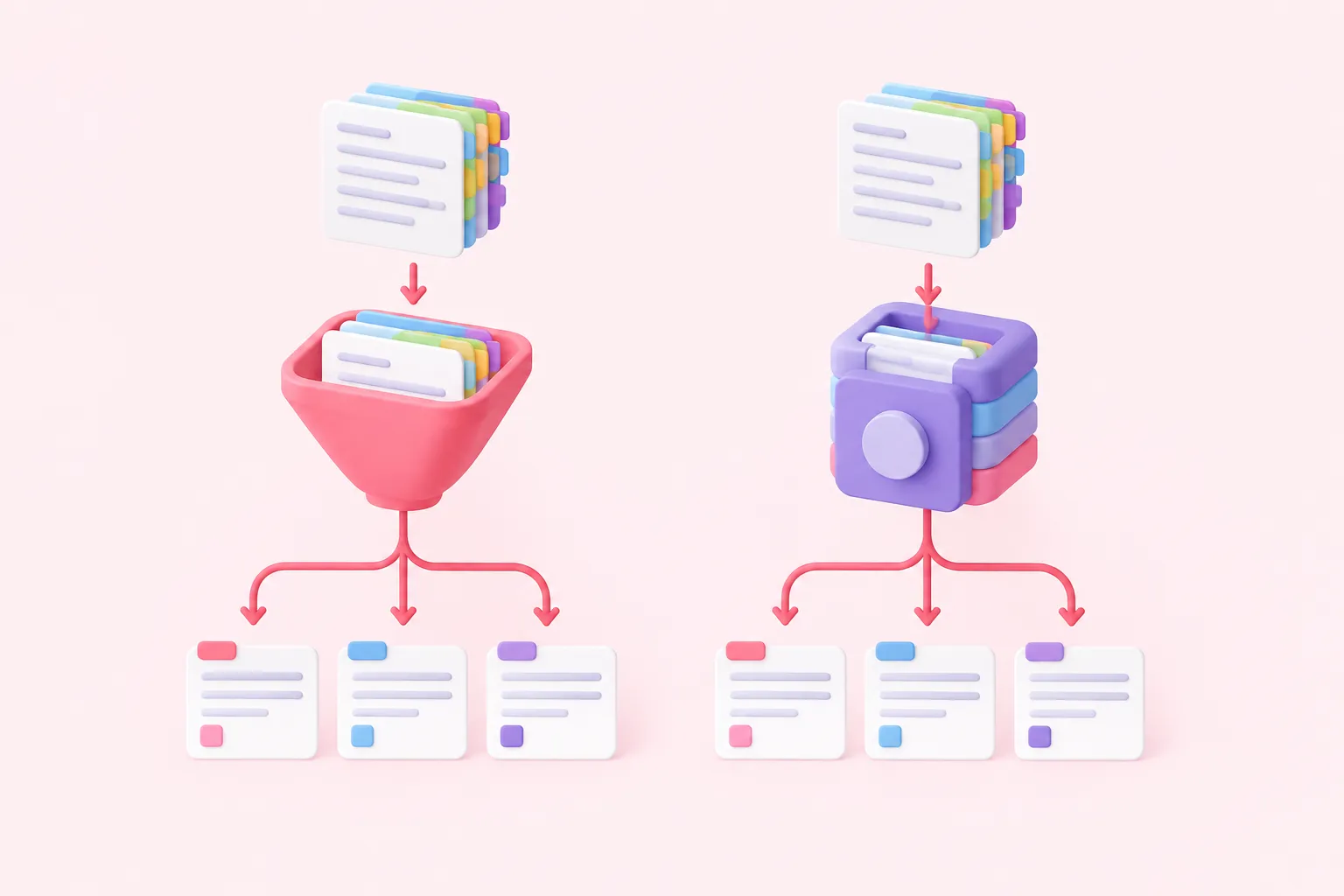
Neither retrieval guide reviewed for this comparison identifies an exact software release.
For Flowise vs n8n, use the same criteria below. Both document metadata options, but available metadata does not guarantee that a generated answer cites the right source or supports every factual statement.
| Criterion | Flowise Agentflow V2 | n8n |
|---|---|---|
| Retrieval prerequisites | Populate Document Stores before semantic retrieval | Ingest documents into a vector store; reuse the embedding model |
| Source traceability | Retriever offers metadata output | Retrieved chunks can include metadata |
| Evaluation method | Datasets, reference outputs and evaluators | Configurable metrics |
| Evaluation eligibility | Built-in evaluations documented for Cloud and Enterprise | Unknown — the cited tutorial does not establish plan eligibility |
| Failure investigation | Server request and error logs | Execution history; retries with original or saved workflow |
| Maintenance ownership | Unknown — future maintenance owner must be established | Unknown — not established by the documentation reviewed |
Sources: The Future of Flowise, Flowise/LICENSE.md at main · FlowiseAI/Flowise · GitHub, Agentflow V2 | FlowiseAI, n8n-docs/docs/build/integrate-ai/understand-ai-components/retrieve-relevant-context.md at main · n8n-io/n8n-docs · GitHub, Evaluations | FlowiseAI, Building your own LLM evaluation framework – n8n Blog, Environment Variables | FlowiseAI, View all executions | Build | n8n Docs
Use a shared evaluation record

Flowise’s documented evaluation eligibility does not establish post-shutdown service availability or purchasing access; Agentflow Latency is listed as forthcoming, not available. n8n’s evaluation tutorial dated December 15, 2025 recommends human review of model-based judging, but does not establish document-assistant performance.
The following is a suggested comparison protocol. Use a shared results sheet if built-in evaluation access is unconfirmed, and keep observed quality, latency and usage separate from developers’ opinions about ease of use.
- Freeze one permitted corpus, source identifiers, question set and reference answers.
- Include answerable, ambiguous and unsupported questions.
- Align models, embeddings and retrieval settings where feasible; record differences.
- Run both prototypes and record answers, sources, latency and usage.
- Have a human inspect the evidence behind each answer, then investigate failures and rerun the unchanged questions after fixes.
Sources: Evaluations | FlowiseAI, Building your own LLM evaluation framework – n8n Blog
Make lifecycle and adoption unknowns decision gates

Flowise’s shutdown announcement scheduled code freeze for July 29, 2026 and stated that active feature development would cease. Its repository records actual archival on August 13, 2026, later than the scheduled archival date. Those facts do not establish independent forks’ maintenance status or continued hosted availability, commercial support or security maintenance.
Flowise’s repository license distinguishes commercially licensed enterprise and explicitly marked files from remaining Apache-licensed content. It does not resolve rights for a particular deployment or fork. The documentation reviewed for this comparison also leaves n8n’s current licensing terms, comparable access controls, deployment suitability and scaling requirements unresolved. Treat these as adoption gates rather than scoring them by assumption.
For readers searching for “Flowise vs n8n Reddit” discussions, this comparison does not assess Reddit discussions. In our view, a promising prototype should remain a prototype until someone owns maintenance and the unresolved adoption gates have answers.
Flowise’s logging documentation does not establish retention, redaction or access controls. n8n’s retries use previous execution data and do not guarantee recovery; deleting a workflow deletes its execution history.
Sources: The Future of Flowise, Flowise/LICENSE.md at main · FlowiseAI/Flowise · GitHub, Environment Variables | FlowiseAI, View all executions | Build | n8n Docs