

n8n vs Zapier vs LangChain: Choosing a Tool for AI Agents
A criteria-based review comparing n8n vs Zapier vs LangChain for building AI agents, covering hosting control, reliability and cost from each vendor's own docs.

Checked against the cited sources on .
What Building an AI Agent Means in Each Tool
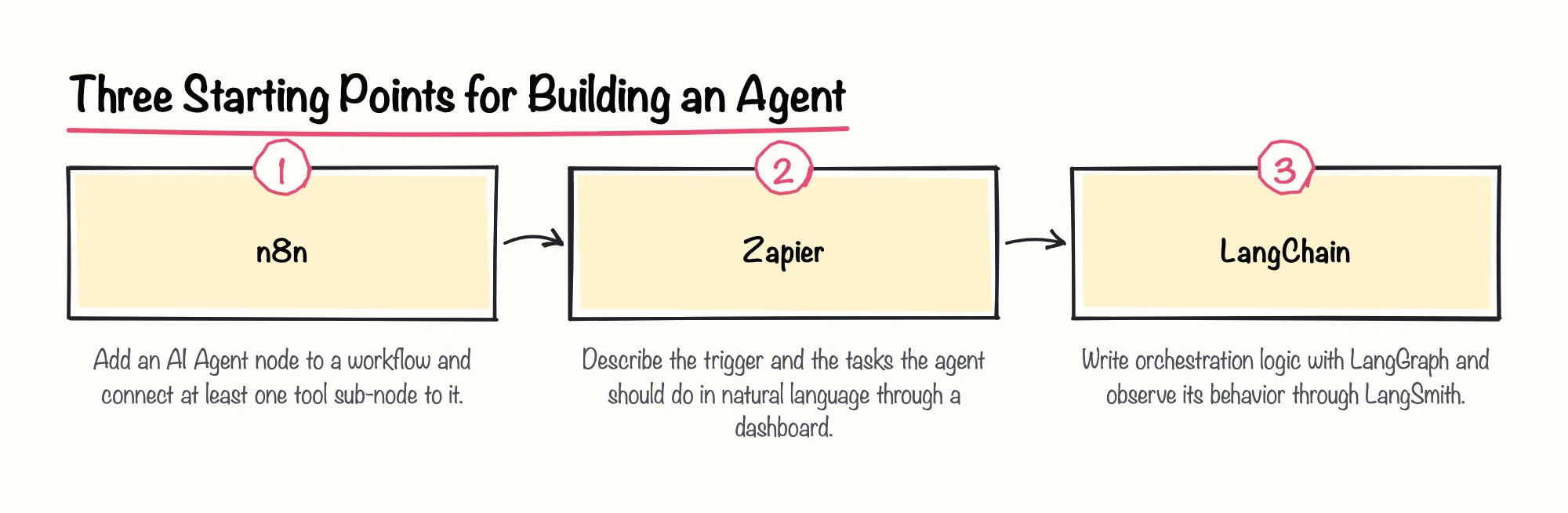
Comparing n8n vs. Zapier vs. LangChain for building and operating AI agents starts with a basic disagreement about what "building an agent" even means. n8n ships an AI Agent node that becomes an agent once wired into a workflow, so building means configuring and connecting nodes inside a visual canvas. Zapier frames the same job as describing, in plain language, what should trigger the agent and which tasks it should complete, handled through a dashboard rather than a canvas or code editor. LangChain's founder describes the product differently again: orchestration tooling (LangGraph) paired with observability tooling (LangSmith) for teams building and debugging their own custom agent logic.
n8n treats an agent as one configurable node that can act as different agent types depending on its settings, rather than offering separate products for each use case. That single-node model sets expectations for how flexible, and how code-free, building actually feels, which the next section looks at directly.
Sources: AI Agent | Nodes | n8n Docs, What agents do | Build | n8n Docs, Build an agent in Zapier Agents – Zapier, LangChain’s Harrison Chase on Building the Orchestration Layer for AI Agents | Sequoia Capital
Ease of Build and Customization Depth
In n8n, a workflow is not agent-ready until at least one tool sub-node is connected to the AI Agent node, a hard prerequisite documented in n8n's own node reference. Once connected, the agent does not run as a single pass: it executes multiple internal steps per invocation, covering setup, tool calls and evaluation, which shapes how a team debugs failures later. n8n's founder, Jan Oberhauser, has described the product's openness toward whichever model or tool fits a given job.
Zapier's instruction-based builder removes node configuration entirely: a team writes what should trigger the agent and what it should do, and Zapier interprets that into working automation. That speed trades away granular control. Zapier Agents are personal, account-bound automations that cannot be embedded on a website or exposed as a shared, customer-facing product, which limits how far a team can operationalize one beyond internal use. In our view, that trade-off makes Zapier's instruction-based builder a reasonable starting point for a single internal workflow, but not a foundation to build a customer-facing agent on.
Sources: AI Agent | Nodes | n8n Docs, What agents do | Build | n8n Docs, Build an agent in Zapier Agents – Zapier
Hosting Control: n8n vs. Zapier vs. LangChain Compared

Hosting control is where the three tools diverge most sharply. n8n ships a free, self-hosted Community Edition on GitHub, giving a team full control over where agent data and execution run without a licensing fee, and its entry-level Cloud Starter plan already includes agent, MCP and AI node capability without any self-hosted infrastructure. Zapier Agents, by contrast, exists only as a hosted, account-bound service: the documentation confirms agents cannot be embedded elsewhere or run outside Zapier's own infrastructure. n8n's founder, Jan Oberhauser, has characterized this self-hosting option in his own words in a recorded interview:
LangChain's LangSmith Deployment, formerly called LangGraph Platform, documents the widest spread of hosting models: fully managed Cloud, a hybrid split between LangChain's control plane and a team's own infrastructure, and full self-hosting. That self-hosted option, however, requires LangChain's Enterprise plan, a cost gate that n8n's free Community Edition does not impose. We'd flag that gap before a team assumes "self-hostable" means the same thing across vendors: on LangChain it is a paid-tier privilege, while on n8n it is the free default.
| Tool | Self-hosting available | Free or entry point | Note |
|---|---|---|---|
| n8n | Yes, Community Edition | Free self-hosted Community Edition, or Cloud Starter for a hosted option | Business-tier production features are covered in Production Reliability Signals below |
| Zapier | No | Hosted account-bound service only | Agents cannot be embedded or run outside Zapier's infrastructure |
| LangChain | Yes, via Enterprise plan or a limited free Developer self-host | Free Developer plan with limited self-host execution volume | Full self-hosting otherwise requires the Enterprise plan |
Sources: n8n Plans and Pricing - n8n.io, Build an agent in Zapier Agents – Zapier, LangSmith Deployment - Docs by LangChain, LangGraph Platform is now Generally Available: Deploy & manage long-running, stateful Agents, Claude Code Killed n8n. Its CEO Disagrees. - Product Growth
Production Reliability Signals
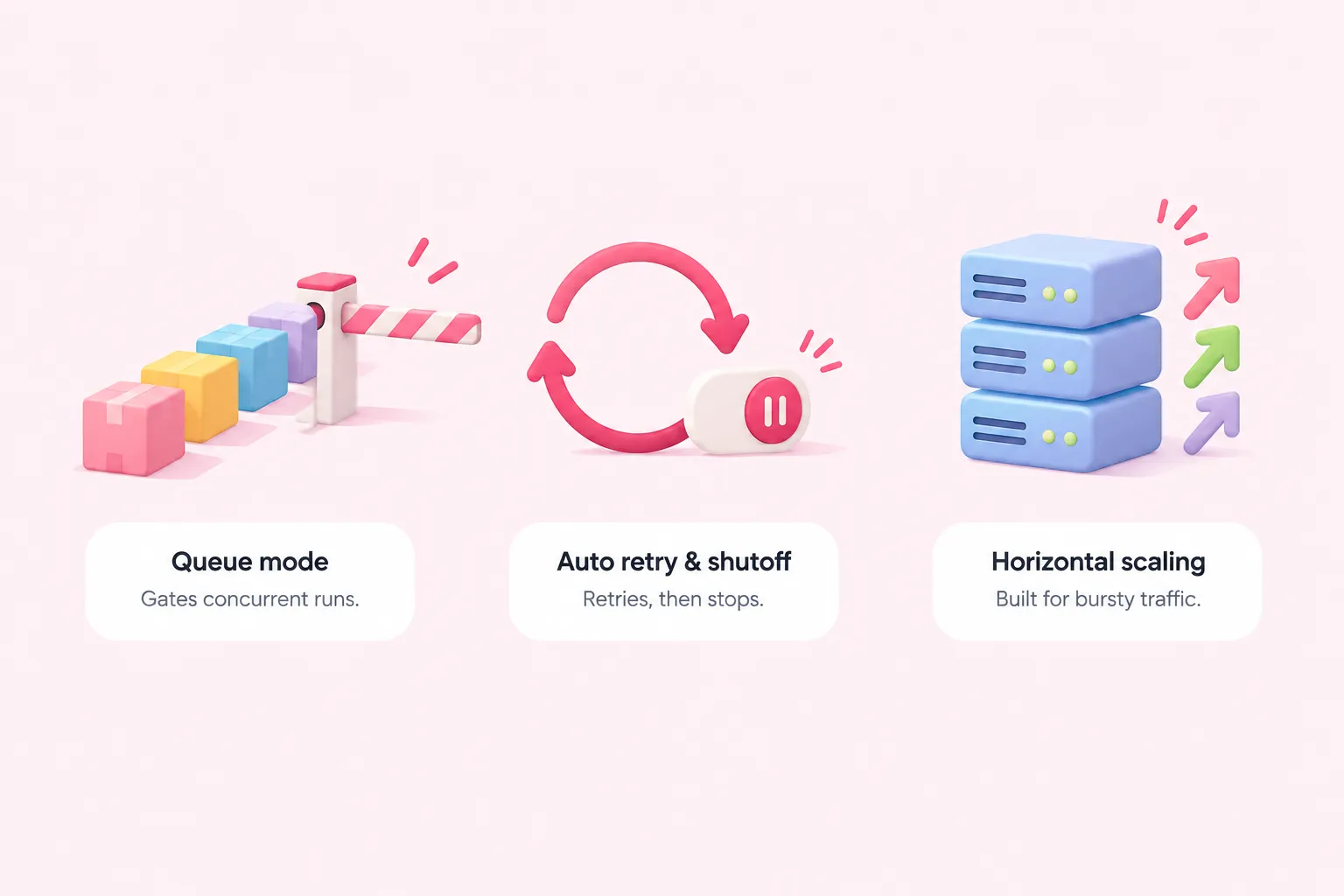
Reliability safeguards are documented differently across the three tools. n8n gates queue mode, its scaling mechanism for concurrent workflow runs, behind the Business plan, and that plan is offered only as self-hosted rather than on n8n's own Cloud. A team on n8n's entry-level plans should treat queue mode as something to add later, not assume by default.
Zapier's underlying Zap infrastructure documents two safeguards: Autoreplay, which keeps retrying a failed step before marking a run permanently errored, and an automatic shutoff once 95% of a workflow's runs error within seven days. Nothing in the supplied documentation confirms whether Zapier Agents specifically inherit this behavior, as opposed to ordinary Zaps, so that remains a gap to verify directly with Zapier before relying on it for an agent in production.
LangChain documents horizontal scaling as a built-in feature of its deployment infrastructure, aimed at bursty or long-running agent traffic, alongside the Cloud, Hybrid and self-hosted deployment options already described above.
Sources: n8n Plans and Pricing - n8n.io, Zapier integration API outage error handling reference, How to troubleshoot errors in Zap workflows – Zapier, LangGraph Platform is now Generally Available: Deploy & manage long-running, stateful Agents, LangSmith Deployment - Docs by LangChain
Cost and Plan Structure
None of the three tools publish a single price for "running an agent," but each documents a ladder. n8n's path runs from a free self-hosted Community Edition, through a Cloud Starter plan that already includes agent and AI node capability, up to a Business plan that adds queue mode, whose self-hosted-only availability is covered in Production Reliability Signals above. Comparing n8n vs. Zapier vs. LangChain on cost structure means comparing where each vendor places its free tier, not just its top price.
LangSmith's entry Developer plan is free with limited usage, and its paid Plus plan adds managed deployment access for a documented per-seat fee before usage-based charges apply. LangChain's Enterprise plan is the tier that unlocks self-hosted and hybrid deployment, though the company has also documented a free, limited self-hosting path for individual developers through the Developer plan, capped at a documented monthly node-execution volume.
Zapier's own documentation, in the material reviewed here, does not state a specific price for its Agents plan beyond its usage limits, so a direct cost-per-seat comparison against n8n's and LangChain's published tables is not possible from the sources used for this review.
Sources: n8n Plans and Pricing - n8n.io, LangSmith Plans and Pricing, LangGraph Platform is now Generally Available: Deploy & manage long-running, stateful Agents
Perception vs. Documented Capability — and Which Team Fits Where

Some of what circulates about these tools is perception rather than documented behavior. n8n vs. Zapier vs. LangChain rankings in blog posts or founder interviews are a different kind of evidence than official plan pages. An independent newsletter writer's own tool ranking placed n8n above Zapier in an unspecified tier system; the writer's criteria are not described in the material reviewed, which makes it one blogger's opinion rather than a measured benchmark. Jan Oberhauser has also described n8n, in an interview, as running on a team's own infrastructure, a self-reported framing worth checking against the official self-hosting documentation already cited above rather than taking on its own.
We're optimistic about where all three tools are heading: configurable, pluggable agent components that a team can swap models and tools into look like the direction the whole category is converging on.
A team that wants a visual, self-hostable builder with full control over where agent data runs should start from n8n's AI Agent node and its Community or Business editions. A team that wants the fastest possible build with no infrastructure to manage, for a personal or small-team use case, should evaluate Zapier Agents against its documented account-bound limits. A team that needs code-level control over agent logic and deep integration with an existing engineering pipeline should evaluate LangChain's LangGraph and LangSmith stack.
Sources: Claude Code Killed n8n. Its CEO Disagrees. - Product Growth