
n8n HTTP Request Node Exercise: Route Responses and Bound Polling
Practise inspecting the n8n HTTP Request node response, routing controlled fixtures and designing polling with separate completion and escalation outcomes.

Checked against the cited sources on .
Editorial exercise: task, prerequisites and inputs

Use the n8n HTTP Request node to inspect controlled responses, then design a polling flow that distinguishes completed work, pending work and escalation. This is an editorial exercise: the proposed workflow has not been executed or validated. Its deliverables are a response-routing workflow, a polling design and evidence explaining every exit path.
You need your own n8n environment, basic API knowledge and instructor-provided controlled endpoints. The instructor must supply the request methods, headers, bodies and response sequences described below; this article does not provide a fixture server. Use synthetic inputs and keep company data out of the exercise.
Treat these fixtures as authored exercise contracts, not universal HTTP semantics. Microsoft’s Asynchronous Request-Reply guidance distinguishes an initial 202 acknowledgement from a status request that returns 200 while work remains pending. Define completion from the fixture’s documented state, rather than its status code alone.
| Fixture | Authored response sequence | Expected outcome |
|---|---|---|
| Immediate completion | 200 with state completed | Completed |
| Asynchronous work | 202, then 200 pending, then 200 completed | Poll, then complete |
| Empty response | 204 with no body, defined as complete | Complete without reading a result body |
| Never completes | 202, then repeated 200 pending | Escalate at the ceiling |
We think the useful skill here is explaining why a branch exists before adding more nodes. A workflow diagram should make its stopping decisions understandable to another developer.
Sources: Asynchronous Request-Reply Pattern - Azure Architecture Center | Microsoft Learn
Inspect the n8n HTTP Request node response

Enable Include Response Headers and Status. n8n’s HTTP Request documentation says this returns the headers and status code alongside the body. Inspect the actual output for each fixture before writing routing expressions, recording the returned status, available headers and body shape.
For downstream routing, use the fields returned in that output. n8n’s expression reference limits $response.statusCode to the HTTP Request node; do not assume that expression is available in later nodes. The suggested inspection sequence below keeps the response contract separate from assumptions about field paths.
- Run each supplied fixture and save the observed output shape.
- Identify the returned status field and any documented body-state field.
- Write a routing rule for every fixture before connecting branches.
- Route an unexpected status or state to escalation with a reason.
Record any polling-location or delay headers the fixture provides, but do not make them control this exercise’s loop. Header-driven polling, missing-header handling and delay parsing need their own implementation specification. Use an instructor-specified polling endpoint and a fixed exercise interval instead.
Sources: n8n-docs/docs/integrations/builtin/core-nodes/n8n-nodes-base.httprequest/README.md at main · n8n-io/n8n-docs · GitHub, n8n-docs/docs/build/work-with-data/transform-data/expression-reference/httpresponse.md at main · n8n-io/n8n-docs · GitHub
Design polling with separate exit paths
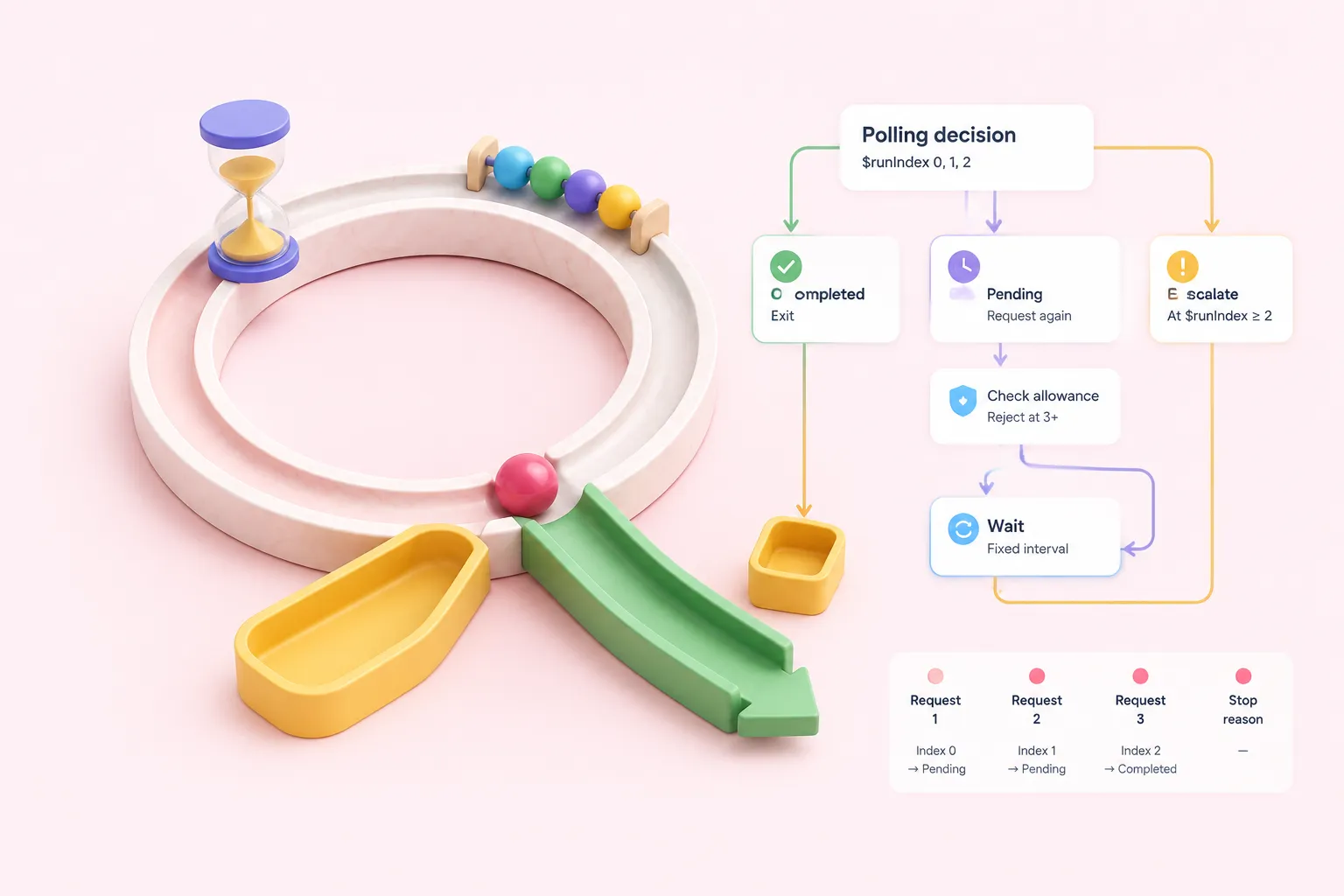
For the n8n HTTP Request node polling design, define a ceiling before starting. As an editorial constraint, allow at most three status requests after the initial acknowledgement; this is not an operating default. Preserve an operation identifier, polls made, ceiling, last response and stop reason. Submit an annotated polling design; this article does not provide a copyable loop implementation.
n8n’s official looping reference requires explicit termination and a run-index ceiling for reset-mode polling, and describes Loop Over Items typeVersion 3 output wiring. For this editorial design, specify one post-response decision node evaluated once per status response: its zero-based $runIndex values 0, 1 and 2 correspond to requests one, two and three. Check completion first; otherwise, escalate pending work when $runIndex is at least 2. Before requesting again, the separate allowance check must reject polls made of 3 or more.
These checks describe the same three-request allowance, not two independent budgets. Their executable configuration and state preservation remain outside this exercise’s implementation instructions. n8n’s Wait documentation supports an interval through Wait Amount and Wait Unit; its webhook-specific Limit Wait Time is not a polling-loop deadline.
Use the following suggested decision sequence. Work through responses pending, pending, completed and pending, pending, pending, recording each request number, decision-node run index and destination.
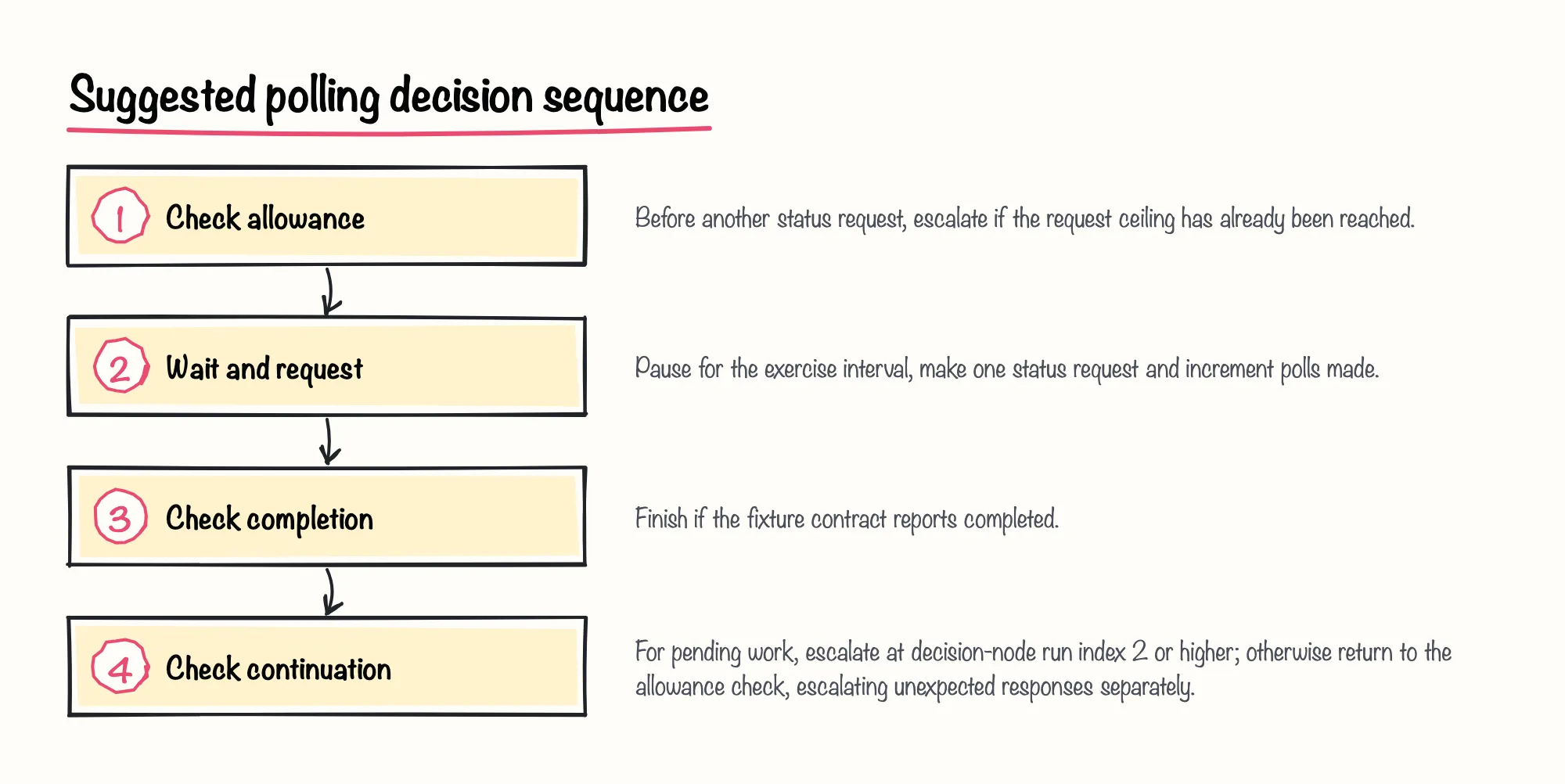
We’d keep the first version limited to a request-count ceiling and fixed interval. In our view, making those exits inspectable is more useful than adding deadline arithmetic before the state contract is clear.
Sources: n8n-docs/docs/integrations/builtin/core-nodes/n8n-nodes-base.wait.md at main · n8n-io/n8n-docs · GitHub, skills/skills/n8n-loops-official/references/LOOP_OVER_ITEMS.md at main · n8n-io/skills · GitHub
Completion criteria and reflection

For the n8n HTTP Request node exercise, submit the routing workflow, saved fixture outputs and annotated polling design. If you also implement the loop, demonstrate how its operation identifier and counter survive each HTTP response. Use this suggested checklist to review the submission.
This exercise does not specify a release-specific fix for empty-body parsing failures; if one occurs, record the installed release, response-format setting and failure rather than treating an unverified workaround as the solution.
For reflection, explain why a successful status request can still represent pending work, which fields must survive the next request, and justify your final-response decision. A suggested solution sketch has four distinct destinations: immediate completion, completion after polling, continued polling and escalation.
Sources: Asynchronous Request-Reply Pattern - Azure Architecture Center | Microsoft Learn